

Global Electric Massagers Market to Hit USD 42.5B by 2035 | Asia-Pacific Leads | Panasonic, Beurer Drive Growth
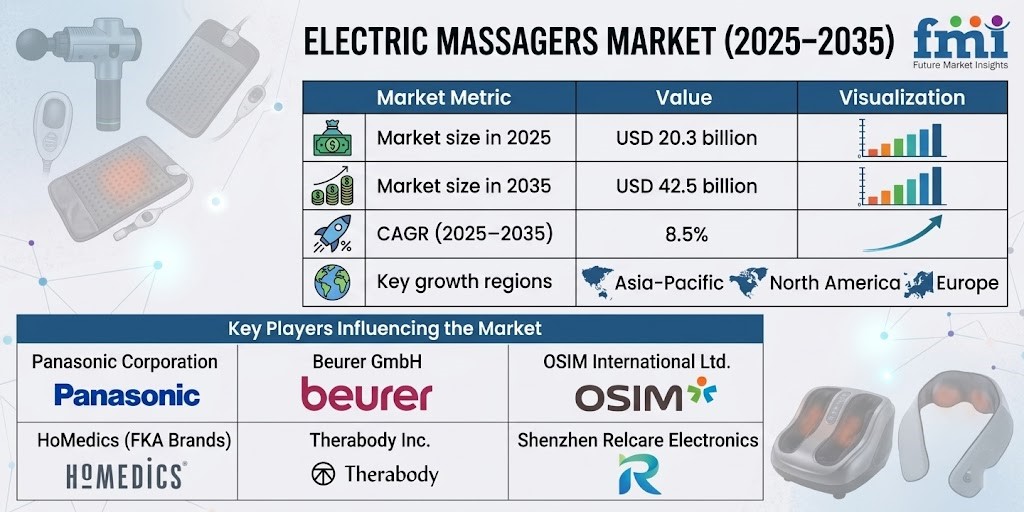
Electric Massagers Market
Global market expands at 8.5% CAGR as Asia-Pacific dominates; key players Panasonic, Beurer, OSIM, and Therabody boost innovation demand
NEWARK, DE, UNITED STATES, March 27, 2026 /EINPresswire.com/ -- The global electric massagers market is set to witness robust growth over the next decade, expanding from USD 20.3 billion in 2025 to USD 42.5 billion by 2035, registering a CAGR of 8.5%. According to the latest analysis, market growth is driven by increasing consumer focus on health and wellness, rising prevalence of muscle fatigue and stress-related conditions, and rapid advancements in smart massage technologies.
The growing preference for convenient, at-home therapeutic solutions is reshaping the personal wellness landscape. Electric massagers, with features such as AI-powered pressure adjustment, app connectivity, and heat therapy, are emerging as essential tools for relaxation, recovery, and pain management.
Electric Massagers Market Snapshot (2025–2035)
• Market size in 2025: USD 20.3 billion
• Market size in 2035: USD 42.5 billion
• CAGR (2025–2035): 8.5%
• Leading product type: Handheld massagers (~56% share)
• Dominant technology: Vibration massagers (~63% share)
• Key growth regions: Asia-Pacific, North America, Europe
• Fastest-growing countries: China, India, United States, United Kingdom, Germany
Request For Sample Report | Customize Report |purchase Full Report – https://www.futuremarketinsights.com/reports/sample/rep-gb-8290
Market Momentum
The electric massagers market begins at USD 20.3 billion in 2025 and demonstrates a strong upward trajectory throughout the forecast period. By 2030, increased adoption of smart and portable massage devices pushes the market beyond USD 30 billion.
Between 2030 and 2035, growth accelerates as AI-integrated and wearable massage technologies gain widespread acceptance, supported by expanding e-commerce channels and rising consumer awareness of self-care. By 2035, the market reaches USD 42.5 billion, maintaining a steady CAGR of 8.5%.
Why the Market Is Growing
The rising demand for electric massagers is fueled by their ability to deliver effective pain relief, muscle relaxation, and stress reduction without the need for professional therapy sessions.
Consumers are increasingly adopting portable and rechargeable devices for convenience, while fitness enthusiasts and athletes rely on percussion and deep-tissue massagers for recovery. Additionally, the integration of smart technologies such as AI-based muscle scanning, app-controlled settings, and customizable massage programs enhances user experience and drives product adoption.
Healthcare trends also play a critical role, as individuals seek non-invasive, drug-free solutions for chronic pain, fatigue, and lifestyle-related conditions.
Segment Spotlight
Product Type: Handheld Massagers Lead with ~56% Share
Handheld massagers dominate the market due to their portability, affordability, and ease of use. These devices provide targeted relief and are widely preferred for home-based therapy and post-exercise recovery.
Technology: Vibration Massagers Dominate (~63% Share)
Vibration massagers lead the technology segment, offering effective muscle stimulation, improved blood circulation, and stress relief. Their affordability and versatility make them accessible to a broad consumer base.
Regional Growth: Asia-Pacific, North America, and Europe Drive Expansion
Asia-Pacific is projected to be the fastest-growing region, driven by rising disposable incomes, rapid urbanization, and growing awareness of wellness solutions in countries like China and India.
North America leads in market value due to high consumer spending on personal wellness and strong adoption of smart massage devices. Europe maintains steady growth, supported by an aging population and increasing focus on holistic well-being and rehabilitation therapies.
Drivers, Opportunities, Trends, Challenges
Drivers:
• Rising health awareness and demand for stress relief solutions
• Growth in home healthcare and wellness devices
• Increasing adoption of portable and smart massagers
Opportunities:
• AI-powered and personalized massage technologies
• Expansion in sports recovery and physiotherapy applications
• Growth of wearable and app-connected massage devices
Trends:
• Integration of IoT, AI, and heat therapy features
• Surge in e-commerce and direct-to-consumer sales channels
• Demand for ergonomic and eco-friendly product designs
Challenges:
• High cost of advanced smart massagers
• Market fragmentation due to low-cost counterfeit products
• Regulatory compliance for therapeutic-grade devices
Country Growth Outlook (CAGR 2025–2035)
• China: 7.8% CAGR, driven by rapid adoption of smart and AI-enabled massage devices, strong manufacturing capabilities, and expanding middle-class consumer base.
• India: 7.5% CAGR, supported by rising disposable incomes, increasing workplace stress, and growing demand for affordable at-home wellness solutions.
• United States: 7.3% CAGR, fueled by high consumer spending on personal wellness, strong demand for advanced massage technologies, and widespread e-commerce penetration.
• Germany: 7.1% CAGR, led by preference for high-quality, ergonomic, and medically approved massagers along with increasing focus on rehabilitation and physiotherapy applications.
• United Kingdom: 7.0% CAGR, driven by rising awareness of self-care, growing adoption of portable massage devices, and expansion of online wellness product sales channels.
Competitive Landscape
The electric massagers market is moderately fragmented, with competition focused on innovation, product design, and technological integration. Key players are investing in AI-enabled solutions, ergonomic designs, and expanding their digital presence through e-commerce platforms.
Leading manufacturers include Beurer GmbH, OSIM International Ltd., Panasonic Corporation, HoMedics, and Therabody (Theragun).
These companies compete on product performance, smart features, portability, and pricing strategies while forming partnerships across fitness, healthcare, and wellness sectors to strengthen their market position.
Conclusion
The electric massagers market is set for strong expansion through 2035, driven by the convergence of wellness trends, technological innovation, and consumer demand for convenient, at-home therapeutic solutions. As smart and personalized massage technologies continue to evolve, the market is expected to witness sustained growth across both developed and emerging regions.
Why FMI: https://www.futuremarketinsights.com/why-fmi
Explore more research reports by FMI
Foot Care For Diabetic Patients Market: https://www.futuremarketinsights.com/reports/foot-care-for-diabetic-patients-market
Anti-Dandruff Agents Market: https://www.futuremarketinsights.com/reports/anti-dandruff-agents-market
Anti-Allergenic Agents Market: https://www.futuremarketinsights.com/reports/anti-allergenic-agents-market
About Future Market Insights (FMI)
Future Market Insights, Inc. (FMI) is an ESOMAR-certified, ISO 9001:2015 market research and consulting organization, trusted by Fortune 500 clients and global enterprises. With operations in the U.S., UK, India, and Dubai, FMI provides data-backed insights and strategic intelligence across 30+ industries and 1200 markets worldwide.
Sudip Saha
Future Market Insights Inc.
+1 347-918-3531
email us here
Legal Disclaimer:
EIN Presswire provides this news content "as is" without warranty of any kind. We do not accept any responsibility or liability for the accuracy, content, images, videos, licenses, completeness, legality, or reliability of the information contained in this article. If you have any complaints or copyright issues related to this article, kindly contact the author above.
